The Source
Open Enrollment:
November 9 - 16
27 Paychecks in 2027 — Plan Ahead
What this means for you:
-
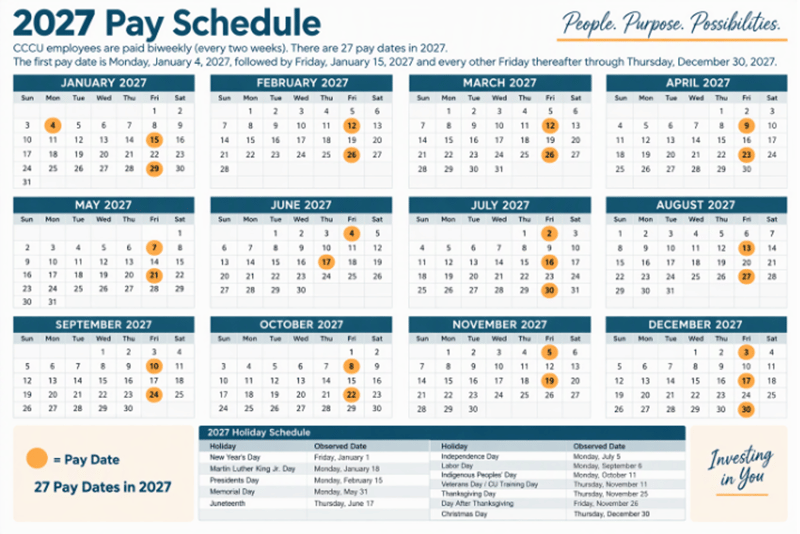
27 pay dates in 2027
-
Salary Exempt? Your annual salary will be divided across 27 paychecks instead of 26 in 2027.
-
January, July & December each have three pay dates
-
Benefit deductions are taken twice per month, so not every paycheck in a three-paycheck month will include benefit deductions
-
First 2027 pay date: Monday, January 4
Once every 13 years there is a collection of days that result in an extra pay period. This is due to a collection of 365th days (in a biweekly pay schedule) and extra leap days. In 2027 there will be an extra pay period. This means you will receive 27 pay checks in 2027.
January, July, and December will have three pay dates. The first pay date is Monday, January 4, 2027. This is due to the way CCCU’s paychecks are processed during the year end holiday.
Benefit deductions occur semi-monthly. In January, benefit deductions occur on last two paychecks of the month, other months with three paychecks, deductions occur on the last two paychecks of the month.
Supporting Your Health, Well-Being, and Future.
At CCCU, we know benefits are about more than insurance. You want support for you and your family through every stage of life. That's why we offer a comprehensive package of health, financial, and wellness benefits designed to help you thrive both at work and at home.
Whether you're enrolling in benefits, planning for the future, or looking for support, we're here to help you make informed decisions and get the most from your benefits.
New Hire Enrollment

Coverage Starts
Enroll Promptly
Eligibility
Retirement Eligibility
Benefits Available to You
Health & Wellness
Dental
Vision
Everyday Assistance Program
Spending & Savings
Flexible Spending Accounts (FSA)
Financial Protection
Life and Disability Insurance
Accident Insurance
Critical Illness Insurance
Hospital Indemnity Insurance

New Hire Checklist
- Review The Source for benefit plans, contacts, and details.
- Complete your Paycom enrollment and add eligible dependents.
- Designate beneficiaries; dates of birth and Social Security numbers are required.
- Download benefit provider apps and save important contact information.
Employee Benefits Guide

Eligibility Dependents
You may enroll the following eligible dependents in applicable plans:
Spouse or Registered Domestic Partner
Children through age 26, including:
- Biological children
- Stepchildren
- Adopted children
- Children for whom you have been granted legal guardianship
- Unmarried children age 26 or older
- Must be primarily dependent on you for support due to a qualifying disability that began before age 26
- Documentation is required
Disabled Adult Children
- Unmarried children age 26 or older
- Must be primarily dependent on you for support due to a qualifying disability that began before age 26
- Documentation is required
- Important reminder: Documentation may be requested to verify dependent eligibility.
Plan Documents: This website provides a summary of your benefits. If information on this site differs from official plan documents, insurance contracts, or applicable laws, those documents will govern. CCCU reserves the right to amend or terminate benefit plans at any time.
Insurance Plans
PPO
A copay plan pairs a lower deductible with predictable copays for certain covered services, making those costs easier to plan for. In exchange, you pay higher monthly premiums. Copays do not count toward your deductible, and other covered services may be subject to the deductible and coinsurance.
HDHP + HSA
A high-deductible health plan pairs lower monthly premiums with an employer HSA contribution to help you save for eligible healthcare expenses. There are no copays: you pay the cost of covered services subject to the deductible, and those payments count toward meeting it. This means higher upfront costs, but eligible preventive care is generally covered before the deductible.
Take advantage of preventive care, eligible in-network preventive services are covered at 100%, with no deductible or copay. Services must meet the plan’s preventive-care guidelines; diagnostic tests or treatment may have out-of-pocket.

Digital ID Cards
Big news: You never have to worry about misplacing your ID card. It’s always right there on myCigna®, whenever and wherever you need it.
Benefit cards are only digital unless a physical card is requested.
Ask Alex.

Scan to Compare Your Options
plans give you the coverage you need for the least amount of money. It’s free, it’s confidential, and it takes less
than 10 minutes to get some peace of mind for the next year.
Virtual Benefit Education
Get the information you need to feel confident about your benefit elections. Explore the Virtual Benefits Website for plan details, resources, and information about your 2027 benefits.
Cigna OneGuide can help before you enroll. Call 888.806.5094 for help with:
- Transition of care questions
- Prior authorization information
- Provider or network questions
- General questions about moving to Cigna
- Other medical plan questions before making your benefit election
Questions before making your medical election?
Transition of Care
Where Should I Go for Care?
Nurse Line
Medical Plan Benefits
Plan Information
Physician Provider Services
Wellbeing & Support Resources
Everyday Assistance Program (EAP) by Revive
Up to 7 counseling sessions per issue per household family member, including adult children in college
7 Coaching and goal support sessions per employee per year
Financial coaching
Legal consultations
Identity theft assistance
Personal and leadership training
Childcare and eldercare resources
Crisis Counselors available by phone 24/7/365
Leadership Connect: Supporting employees can bring questions, and you don’t have to navigate them alone. HR is always here to listen, talk through concerns, and help you explore next steps—whether it’s an employee situation, development, or something else on your mind. If you’d like another perspective, Revive’s Leadership Connect offers confidential management consultations to talk through a situation and possible approaches. It’s an additional option, not a replacement for Human Resources — we’re here for you whenever you need us.
Behavioral Health Care by Cigna
Employees enrolled in the medical plan have access to: Counseling, Psychiatry, Medication management, Substance use treatment and Virtual behavioral health visits.
Headspace Care virtually connects members with a certified coach via texting and app-based programs to help them manage anxiety, depression and daily stressors. If needed a coach can add a licensed therapist or psychiatrist to the care team.
MDLIVE licensed therapists and board-certified psychiatrists can get your employees back to being their best if they’re feeling overwhelmed, stuck or just not like themselves. It offers talk therapy and coping strategies, plus psychiatric services to assist in assessments and medication management.
Bend Health offers support for mental health, behavioral health and substance use for kids and teens. With a family first approach to care, parents and caregivers are able to stay engaged in the care plan.
Talkspace provides virtual access to licensed therapists via live video and private texting, plus psychiatrist services and additional resources.
Revive EAP
Prescription Drug Resources
Prescription Drug Resources
Search covered medications
Locate network pharmacies
Compare generic and brand-name options
Access home delivery services
Cigna formulary lookup
Drug List Name: Advantage
Specialty Medication is available through Accredo Specialty Pharmacy
Home Delivery Pharmacy
Save time by having maintenance medications delivered directly to your home.
Convenient 90-day supplies
Automatic refill options (if available)
Shipment tracking
Support for long-term medications
Call 800.835.3784 or click below.
Prescription Savings Tools
Compare prescription prices at local pharmacies and determine whether GoodRx pricing may be lower than your insurance copay.
GoodRX is not insurance and cannot be combined with insurance for the same purchase and may not count toward the deductible or out-of-pocket maximum.
Why Consider a Health Savings Account (HSA)?
What does CCCU contribute?
When you’re eligible and enrolled in the HDHP + HSA plan, CCCU contributes $750 annually for employee-only enrollment or $1,500 for enrollment with eligible dependents.
When will I receive the money?
Half is deposited in January and half in July: $375 per deposit for employee-only enrollment or $750 per deposit for dependent enrollment. Later scheduled deposits are the full 50% amount if you remain eligible.
What if I'm a new hire?
Your first deposit is prorated: annual CCCU contribution ÷ 12 × eligible months remaining in the January–June or July–December period.
How much can I contribute?
The IRS annual limit for 2027, including employer contributions, is $4,500 for employee-only coverage or $9,000 for family coverage. After CCCU’s full annual contribution, you can contribute up to $3,750 or $7,500, respectively, if you’re HSA-eligible all year and have no other HSA contributions. Eligible individuals age 55 or older can add a $1,000 catch-up contribution.
What if my eligibility or coverage changes?
For new hires or eligibility or coverage changes, your limit may differ. Subtract your actual employer contribution and any other HSA contributions from your applicable IRS limit.
Where can I get help?
Review our HSA materials or contact HealthEquity at 866.735.8195 for more information
HSA Resources
What is an HSA?
HSA Triple Tax Savings

Limited Purpose Savings Account
If you enroll in the HDHP + HSA plan, an LPFSA lets you set aside pretax dollars for eligible dental and vision expenses while saving your HSA funds for other healthcare needs.
Switching between a healthcare FSA and an LPFSA? To receive eligible carryover funds, you must enroll in the appropriate account for the new plan year, even if you do not want to contribute additional money. In that case, enroll with an annual election of $0. A $0 election establishes the account that will receive your carryover; declining coverage or leaving the account unelected does not. Carryover is subject to CCCU’s plan rules. A healthcare FSA can affect your eligibility to contribute to an HSA, so confirm your account type before HSA contributions begin.
2027 annual employee contribution limit (Healthcare FSA and LPFSA): $3,500.
Maximum eligible carryover from 2027 into 2028: $700, subject to CCCU’s plan rules.
Annual election when enrolling for carryover only: $0. Opening a new account: Minimum annual election is $100
HSA vs. FSA
What is a LPFSA?
Flexible Spending Account (FSA)
A tax-advantage FSA is a great way to save money with pre-tax dollars to reimburse yourself for a wide variety of IRS-eligible health and/or dependent care expenses that are not covered through your other benefit plans. The annual amount you elect to contribute to each account will be divided into equal amounts and deducted from your paycheck pretax, therefore reducing your taxable income.
Elections can be changed at any time via Paycom payroll elections with a qualifying event.

Healthcare FSA
• Pay for eligible health care expenses, such as deductibles, copays, and coinsurance. To learn more, visit Irs.gov and search for publication 502 or visit healthequity.com. To purchase eligible healthcare products, visit Fsastore.com.
• Contribute up to $3,500 (Amount will be based on the 2027 IRS limit).
• All funds must be used within the plan year or the funds are forfeited, except for a limit of $700 which may be carried over from 2027 into the 2028 plan year.
Dependent Care FSA (DCFSA)
• Pay for eligible dependent care expenses, such as daycare for a child, so you and/or your spouse can work, look for work, or attend school full time. To learn more, visit Irs.gov and search for publication 503 or visit healthequity.com.
• Dependent Care FSA (DCFSA) elections are up to $3,500 for single, or married filing jointly separate tax filers and up to $7,500 for married filing jointly.
• Revive can help you find childcare resources. Planning for summer? Ask about help exploring summer camps, too. Call 800-433-2320 to talk through what your family needs and find out what resources are available.
What is a Healthcare FSA?
What is a DCFSA?
FSA Resources
Vision & Dental Benefits
Vision Benefits
Dental Benefits
Medical Leave & Supplemental Insurance
PAID FAMILY MEDICAL LEAVE
Leave & Income Protection
Paid Leave Oregon
CCCU’s Paid Leave Oregon plan provides paid time off for eligible employees to manage a serious health condition, care for a qualifying family member, bond with a new child, complete qualifying foster-placement or adoption processes, or take qualifying safe leave. Eligible employees may receive up to a combined total of 12 weeks, with up to two additional weeks for qualifying pregnancy-related health conditions. Job protection applies after at least 90 consecutive calendar days of employment. Review the Unum Paid Leave Oregon materials and contact HR for application guidance.
Family and Medical Leave Act (FMLA)
FMLA provides eligible employees with up to 12 workweeks of unpaid, job-protected leave in a 12-month period for qualifying family and medical reasons, including new-child bonding, caring for a spouse, child, or parent with a serious health condition, your own serious health condition, and qualifying military-family needs. Eligible military caregivers may receive up to 26 workweeks in a single 12-month period. Group health coverage continues on the same terms during FMLA leave. FMLA does not itself replace your income. Contact HR to confirm eligibility and receive the applicable leave-request and certification instructions.
Short-Term Disability
Income replacement if a covered illness or injury keeps you from working. The benefit covers 66.6667% of weekly income, up to $2,000 per week. The elimination period—the waiting time before benefits begin—is zero days for a covered injury and seven days for a covered illness. The maximum benefit duration is 13 weeks, subject to the elimination period and continued disability. Other income sources may reduce your benefit. Review the plan’s eligibility requirements, exclusions, and limitations.
Long-Term Disability
If a covered disability continues beyond the 90-day elimination period, this benefit may replace 66.6667% of monthly income, up to $10,000 per month. Benefits may continue up to Social Security normal retirement age, subject to continued disability and the plan’s duration rules; different duration rules may apply when disability begins later in life. Other income sources may reduce your benefit, and pre-existing-condition limitations apply. Review the plan materials for eligibility, exclusions, and complete coverage details.
Washington Paid Family & Medical Leave
Eligible employees may receive up to 12 weeks of paid family or medical leave for qualifying reasons. In certain circumstances, combined family and medical leave may total 16–18 weeks. Eligibility and benefit payments are determined by the State of Washington—not Unum. Job protection and continued health coverage have separate eligibility requirements; employees remain responsible for their normal share of health premiums. Apply through Washington’s Paid Leave program.
Important: Leave approval and benefit payments are not the same.
Supplemental Insurance

Accidental Insurance
Hospital Indemnity Insurance
Critical Illness Insurance
Easily File Claims
Life & AD&D
Basic Life and AD&D
Voluntary Life and AD&D
Keeping Your Existing Coverage
When Is EOI Required?
Review Your Beneficiaries
Your CCCU 401(k) & Retirement Resources
CCCU’s 401(k) Profit Sharing Plan can help you build toward your financial future. Whether you’re enrolling for the first time, reviewing your retirement strategy, or looking for financial guidance, the resources below can help.
Manage Your 401(k)
Principal
Access your Principal account to enroll or manage your CCCU 401(k), review or update your contribution rate and investments, check your beneficiaries, and access plan information.

Financial Guidance & Personalized Support
MyOneDigital
Looking for additional financial guidance? MyOneDigital provides access to financial education, planning tools, and personalized support.
Employees can:
- Schedule a 1:1 meeting with advisor Ashley Butz or financial planner Michael Bird
- Access Financial Academy webinars and recordings
- Use financial calculators and planning tools
- Access Principal and additional retirement resources
Learn About Your Plan
401(k) Plan at a Glance
Overview of the CCCU 401(k) Profit Sharing Plan and eligibility.
Contributions
How Much Can I Contribute?
The IRS sets annual contribution limits, which may change from year to year. Traditional and Roth employee contributions share the same annual limit. If you’re age 50 or older by the end of the calendar year, you may be eligible for additional catch-up contributions under the plan. A higher catch-up limit may apply in the year you turn 60, 61, 62, or 63, if permitted by the plan. View IRS 401(k) contribution limits by year
Traditional & Roth Contributions
You can choose pre-tax (Traditional) or after-tax (Roth) contributions. Traditional contributions generally reduce your current federal taxable income; withdrawals are generally taxable. Roth contributions are taxed up front, and qualified withdrawals—including earnings—are tax-free.
Roth Catch-Up Requirements
If your prior-year FICA wages from the employer sponsoring the plan exceed the applicable IRS threshold, your catch-up contributions must be made on an after-tax Roth basis. The threshold may change annually. Review the IRS guidance for the applicable year and contact Human Resources or the plan administrator to confirm how the rules apply to you. View IRS catch-up limits and Roth catch-up requirements
Participation, contribution options, and catch-up availability are subject to the plan’s terms and applicable law.
CCCU Contributions & Vesting
Employer Contributions
CCCU supports your retirement savings by contributing 8% of your gross wages to your pre-tax 401(k) account once you’re age 18 or older and have completed six months of employment.
Vesting: When Contributions Become Yours
Vesting means ownership of the money in your retirement account. You are always 100% vested in your own contributions. Employer contributions become fully vested after three years of vesting service. If you leave CCCU before becoming fully vested, the non-vested portion of your employer contributions will be forfeited.
Enrollment and Investment Support
Before enrolling, you’ll attend an informational session and have access to one-on-one meetings with investment advisors through Principal Financial Group and OneDigital. Principal will walk you through the plan’s investment options and online tools. Through your Principal account, you can view and manage your retirement savings, update your contribution elections, and change how your money is invested.
How to Enroll
Investment Selection Information
Changing Contributions
Where to Go for Assistance
Roth Transfers and Employer Contribution Options
Converting existing retirement savings to Roth is different from choosing Roth treatment for new employer contributions. Contact Principal to confirm which employer contribution options are available under CCCU’s plan. Our plan allows Roth conversions/transfers. Before proceeding, ask Principal about the process and potential tax implications. To find the online option, sign in to your Principal account and look under Contributions for “Roth Transfer.” If you need help locating it, contact Principal.
401(k) Resources & Plan Documents
Looking for something specific? Find enrollment materials, required plan notices, beneficiary information, rollover resources, and other helpful retirement resources below.
Getting Started
Getting Started
Medicare
Employees and eligible dependents age 65+ may be eligible for Medicare Part D prescription benefits outside of CCCU’s group plan, which could reduce out-of-pocket costs. Review our annual notice for how our coverage compares, key deadlines, and where to enroll.

Paid Time Off
2027 Update
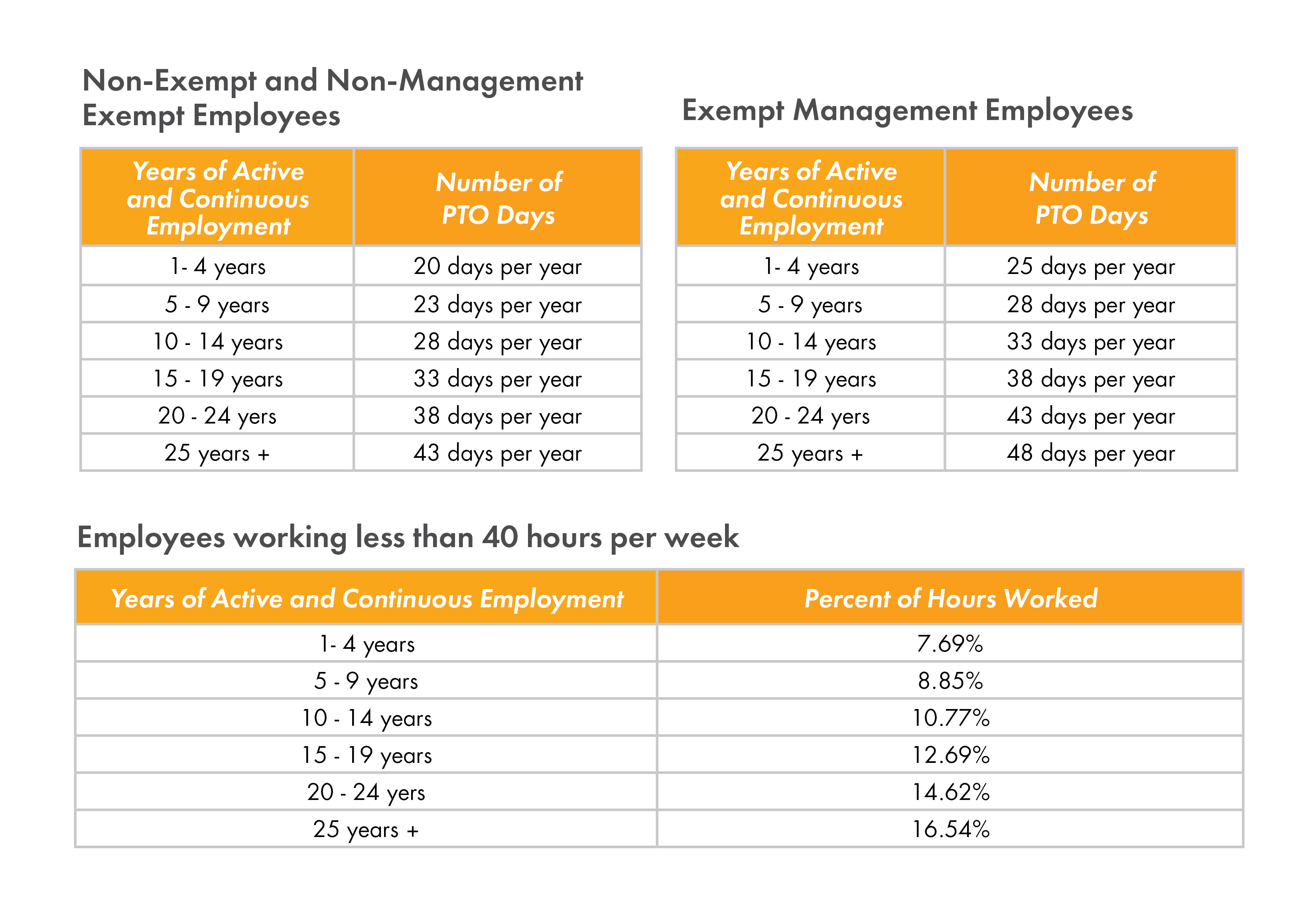
We’re testing a different way to earn paid time off (PTO), with a planned rollout in 2027. Instead of earning a set amount each pay period, you would earn PTO based on your paid hours. Our current process often requires manual adjustments when employees take leave, and we’re exploring this approach to help simplify that process.
Under the model we’re testing, PTO would accrue on all paid hours—including regular hours, overtime, holidays, birthday leave, bereavement, and other paid time off. Unpaid time off would not earn PTO. We’ll share more details as testing continues and before any change takes effect.
Under the proposed approach, the existing PTO tiers for salaried and hourly full-time employees would remain in place. Part-time employees would use the same tiers as full-time employees, with PTO earned based on paid hours. Our goal is to ensure that employees who are paid for their regularly scheduled hours do not earn less PTO than they do today. Depending on the final hourly accrual rates, some employees may earn slightly more. We’re still testing the calculations and working through the details, so we’re not ready to confirm individual outcomes just yet.
We know a change like this brings questions, and we don’t have every answer just yet. We want to be open about where we are in the process and give you room to ask questions along the way. Please reach out to HR with any thoughts, questions, or concerns—we’re here to listen and talk through what this could mean for you. Your feedback is welcome as we work through the details.
Celebrating You!
Your birthday deserves a little time just for you. Enjoy one paid day off during your birthday month to celebrate, recharge, or spend time doing something you love. Please use your birthday day off within your birthday month as it cannot be taken at another time of year or carried over.

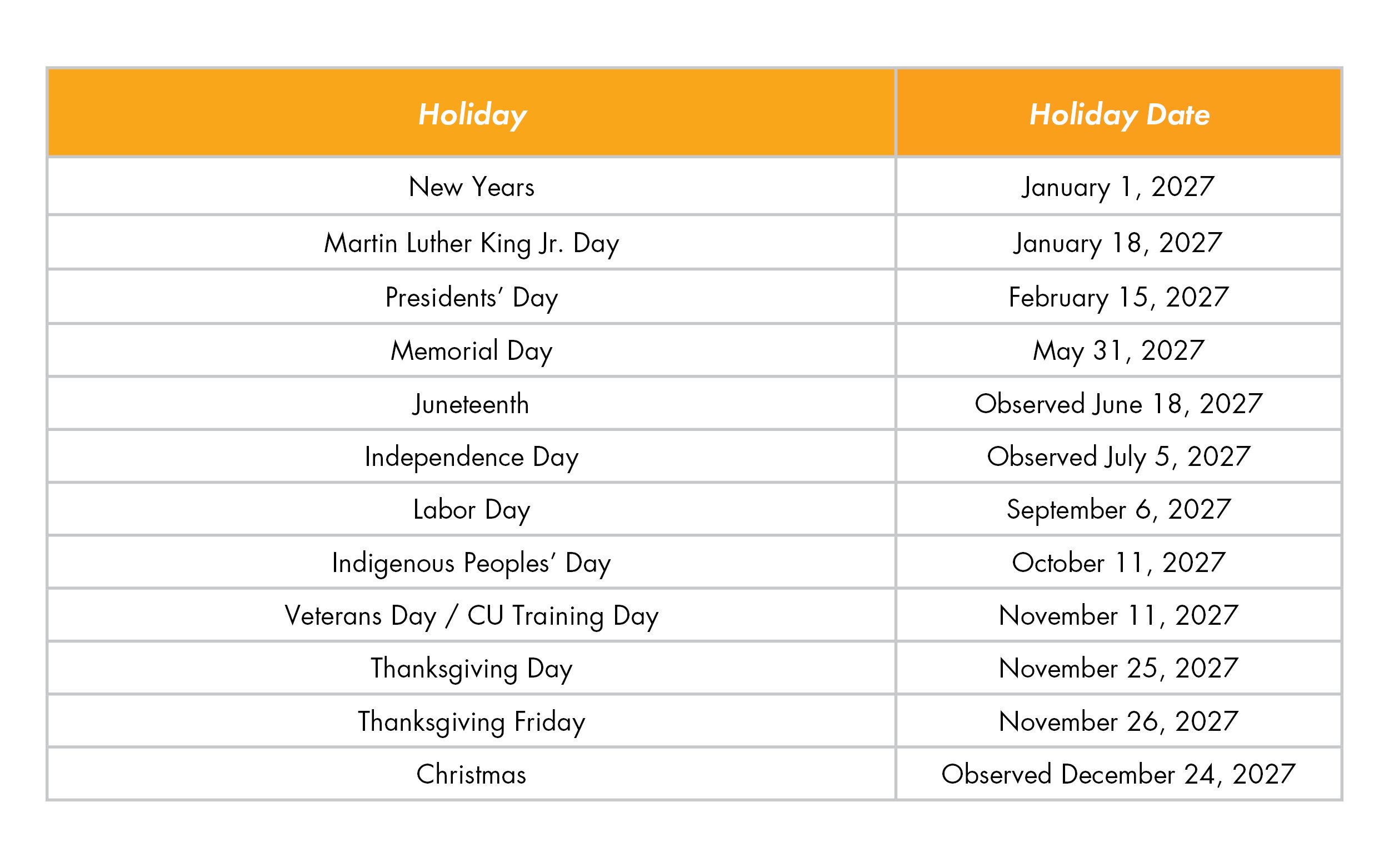
Holiday Pay
All full-time employees are eligible for holiday pay beginning on their first day of employment. Part-time employees are eligible for holiday pay for the number of hours they are typically scheduled to work if the holiday falls on a day they are normally scheduled to work.
We recognize federal holidays observed by the Federal Reserve, unless the holiday falls on a Saturday or Sunday. When a holiday falls on a Saturday, we will observe the holiday on the Friday before. In the event that New Year’s Day is a Saturday, it will not be observed. Any holiday that falls on a Sunday will be observed on the following Monday.
Employees that celebrate a holiday not observed by the Federal Reserve may request to use PTO or unpaid time off for a holiday of a deeply held religious belief. For questions or accommodations, please contact a human resources representative.
Working in the office on a holiday or during inclement weather? Clock in and out as usual, and add a timecard comment asking us to code your hours as “holiday worked” or “inclement weather worked.” This helps us make sure you receive pay for the hours you work, along with your holiday or inclement weather pay.
Forgot to add a comment? That’s okay, we’ve got you! Just let us know so we can help make sure your time is recorded correctly. A little reminder always helps.
Length-of-Service Program
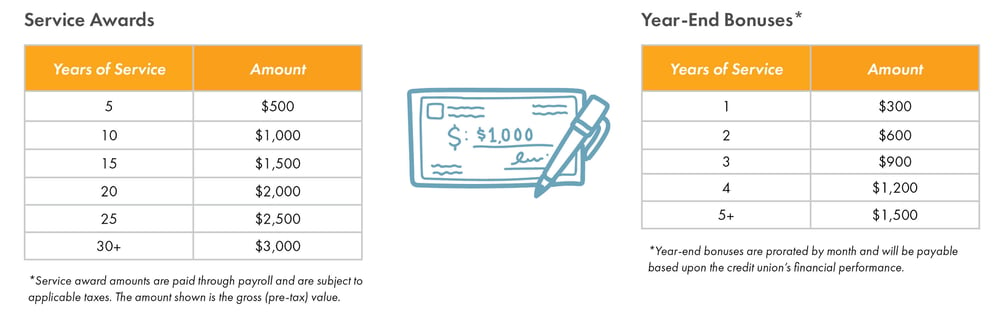
We offer service awards and year-end bonuses to employees based on their years of employment with us.
The chart below represents the amounts for full-time employees working 30 or more hours per week. Part-time employees are paid at 50% of these rates.

Helping Hands
Our workplace giving program, encouraging employees to support our community.
Volunteer/donation day
Need some time off to make the world a better place? We’ve got you covered!
Whether you're helping at a 501(c)(3) nonprofit or lending a hand at your favorite school, we love that you’re giving back to the community.
Once employees have reached 90 days of employment, enjoy 8 hours of time on us to volunteer and know that you're not just supporting a great cause, you’re spreading good vibes all around!
Go ahead, be a hero for the day, we’ll be here cheering you on the whole time.
Sponsored Volunteer Days
We’re excited to offer employees the opportunity to participate in CCCU Sponsored Volunteer Days. These special events, organized in collaboration with our philanthropic partners, typically take place over the weekend. Employees who volunteer outside of their normal working hours will have their volunteer time offset during the regular work week. Opportunities will be emailed to employees as they become available throughout the year. We encourage you to join the fun!
Special Discounts
Perks at Work
Working Advantage
Revive Perks

Your Pay & Compensation
Understanding your pay should be simple. CCCU provides resources to help you understand when you’re paid, how your paycheck works, benefit deductions, and the programs that make up your total compensation.
Pay at a Glance
- Pay frequency: CCCU employees are paid biweekly.
- Pay schedule: View upcoming pay dates and the annual pay calendar.
- Benefit deductions: Learn when benefit deductions are taken and how they appear on your paycheck.
- Your compensation: Explore the pay, benefits, retirement, and other programs that make up your overall CCCU rewards package.
Benefit Deductions
- Most benefit deductions (medical, dental, insurance, FSA/HSA, etc.) are taken semi-monthly (twice per month).
- 401(k) contributions and loan repayments are deducted each biweekly paycheck.
No one from Human Resources will ever contact you asking for personal or confidential information. Additionally, we will never email you from Humanresources@consolidatedccu.com or HR@consolidatedccu.com. It will always be from a direct email address from one of our HR or Payroll representatives. If you ever receive a call or email from someone claiming to be human resources or payroll asking for personal or confidential information, hang up and give us a call on a trusted number.
HR & Benefit Vendor Contact Information
Human Resources Connect
Paycom
Ask here for HR/Payroll Related Questions
HR Hotline
503.797.7597
UNUM
Dental &Vision
Accident, Critical Illness & Hospital Indemnity
Basic and Voluntary Life, AD&D
Total Leave including FMLA, Paid Leave Oregon, Unpaid State Leaves and, Short & Long Term Disability.
T: 866.679.3054
Health Equity
Health Savings Account (HSA)
Health, Dependent Care, and Limited Purpose Flexible Spending Accounts (FSA)
T: 877.924.3967
Revive
Everyday Assistance Program
Access Revive:
Call: 800-433-2320
Text: 503-850-7721
Visit: canopy.myrevive.health
Organization Name: CCCU
Support is available 24/7/365 when you need it most.
Principal
Schedule a one-on-one to discuss your benefit questions.
Pre-Hires and Employees at Home: Sign in as a Guest
At Work: Sign in with Authentication